| The word “bocce” is a plural of the word “boccia” meaning ball in Italian. "Volo," as it is also called by the Italians, derives it’s name from the Italian verb “volare,” meaning “to fly” and refers to the manner of throwing a ball through the air in the attempt of striking away an opponents ball. The French refer to the sport as "Boule Lyonnaise."
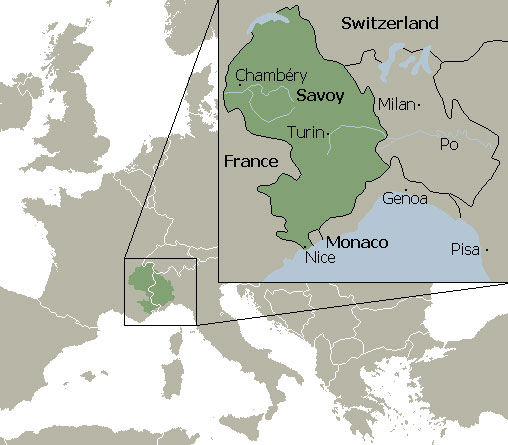
Many believe the ancient Phoenicians, Egyptians, Greeks, & Romans invented an early form of bocce. One theory suggests their soldiers played with rocks to pass time in-between battles. Modern Bocce finds its origins near the cities of Torino, Italy and Lyon, France and stems from the House of Savoy dynasty, which ruled from 1003 to 1860.
 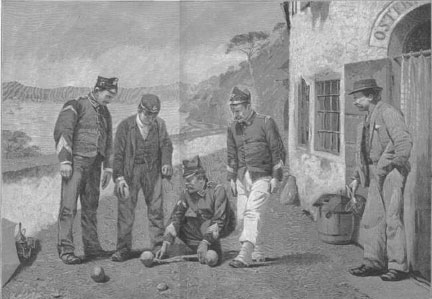
Until the middle of the 19th century players used plain wooden balls made of boxwood, beech or elm. Sometimes their owners would "fortify" them by adding a few blacksmiths' nails here and there. These wooden balls had many defects; they wore out and deformed quickly, especially if the game was played on a hard and rocky ground.
After 1872 factory made nails became available and, applied to ball-making, the results were made for durable balls covered in iron nails with large round heads; and later flathead nails. These balls were larger and heavier (from 100 to 150 mm and up to 1500 g). The makers became real artists using nails of different metals (steel, brass and copper) to set out different designs: symbols, numbers and letters, but also stars, flowers and hearts according to the wants of the players.

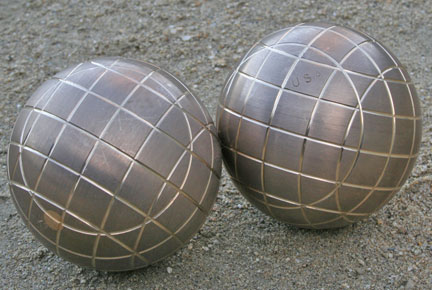
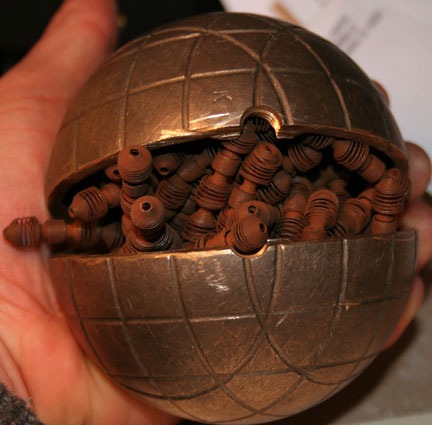
In 1923 metal technology took hold and players since use custom-made bronze balls with variations in weight (900 - 1200g), diameter (90 - 110mm), and pattern, so they can use a ball most suitable for their hand size and throwing style. These balls can be hollow; or filled with an array of non-liquid substances to minimize bouncing.
The first club of Bocce was born in 1850 in Lyon, France and called "Le Clos Jouve" on the "plateau de la Croix-Rousse." The first major competition was The Pentecote tournament Bellecour in Lyon, France in 1895 that still exists today, with thousands of participants. In 1900 Bocce was featured in the Olympic games in Paris, France as an exhibition sport.
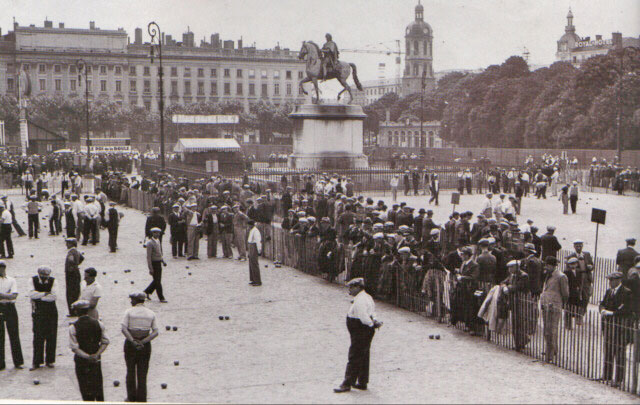
Presently the Confereration Mondiale des Sport de Boules (CSMB) & Federacion International de Boules (FIB) regulate bocce at the international level and dictate the official rules. The sport thrives most in the Mediterranean with France, Italy, Slovenia, & Croatia having the highest level and concentration of players. Over 30 nations participate in World Bocce Championships every odd year.
Player of the 20th Century
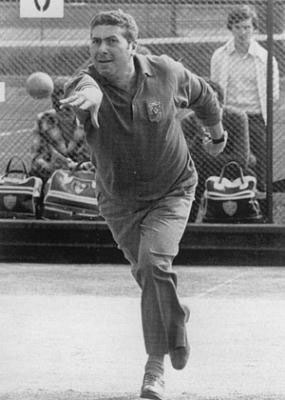
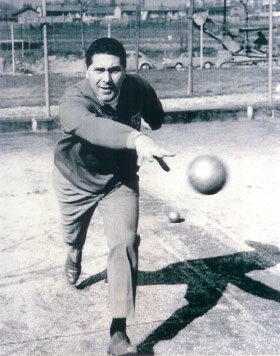
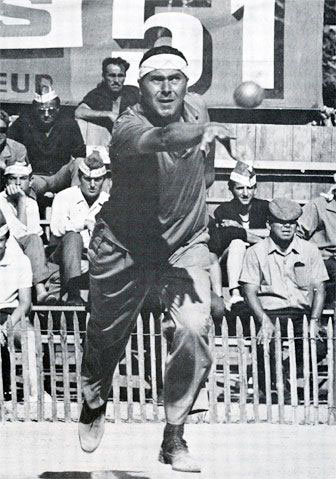
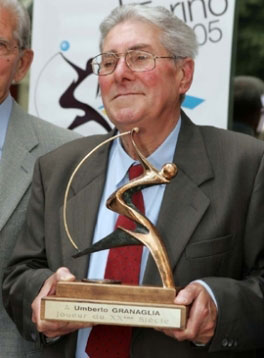
The great Italian Umberto Granaglia (May 20, 1931 – December 13, 2008) is largely considered the best bocce player ever and was named “Player of the 20th Century" by the Confederation Mondiale des Sport de Boules in 2005. In a 23 year career he won more World (13), European (12), and Italian (46) Championships than anyone. His silhouette is recognized throughout the bocce world as his likeness embellishes the perfect player. There are many great bocce champions, past and present, but none as accomplished or famous than Granaglia.
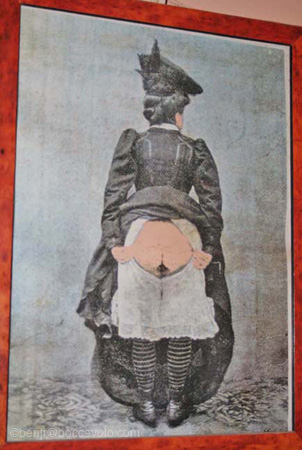
The Legend of Fanny
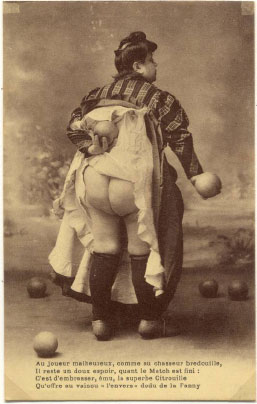
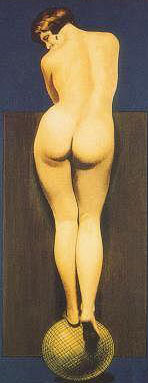
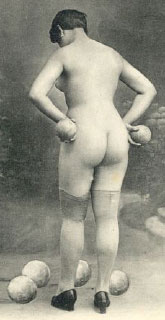
"Fanny" began on the "plateau de la Croix-Rousse" between 1860 et 1870 in Lyon, France. She was not known as a player, but rather a girl who would expose her backside to the losers of the match. The losers would then be obliged to kiss it in defeat! Today it is common for clubs to have a picture or sculpture of Fanny thus providing something to kiss for anyone who loses without scoring a single point.
Geometry of Bocce
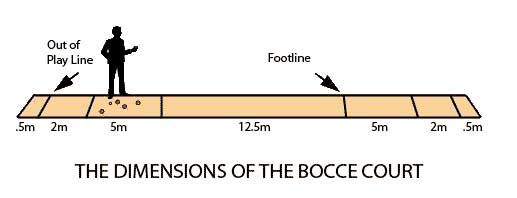
True bocce courts correlate to the ancient "golden ratio"a.k.a"Phi" = 1.6 = 8 / 5 =  : :
Court length = 27.50 m, maximum width = 4 m, K = (27.5 / 4) = 6.8534, which is exactly 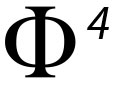 . .
For the minimum width = 2.5 m, the ratio is K = (27.5 / 2.5) = 11, i.e. 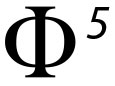 . .
The ratio between minimum and maximum width is 4 / 2.5 = 8 / 5 = 1.6 = .
|